Case study
Viollet
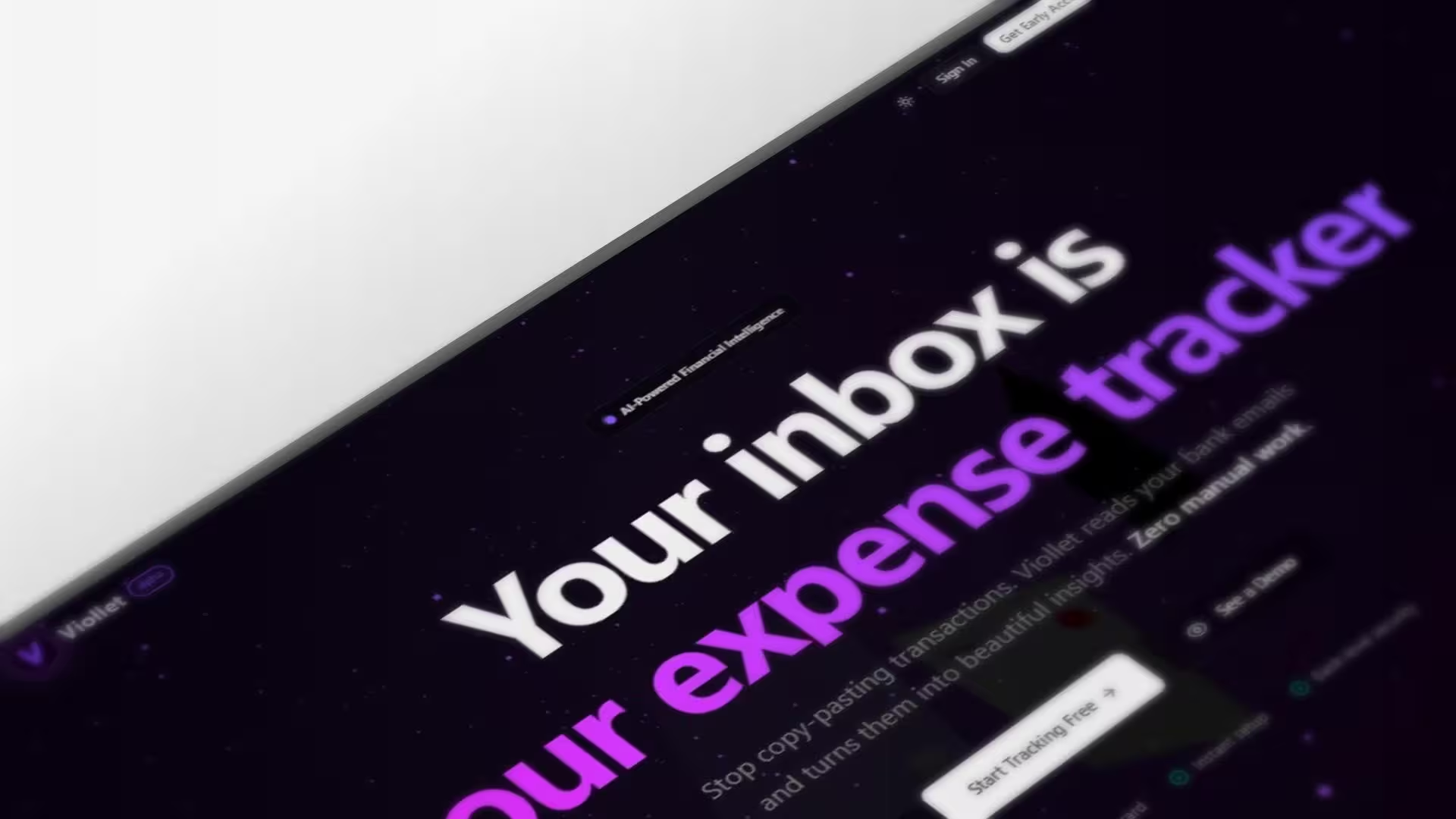
Viollet is a side project I designed and built end to end: connect Gmail, ingest bank transaction notifications, categorize spend with AI, and surface budgets and insights—without asking users for online banking credentials.
- Role
- Solo builder — architecture through production
- Year
- 2026
- Read time
- 8 min read
- TypeScript
- Next.js
- Turso
- Drizzle
- Clerk
- AI SDK
- Gmail API
- Google Pub/Sub
- Webhooks
1. Context
Most personal finance apps still depend on manual logging or direct bank integrations that are hard to ship, expensive to maintain, and often unavailable for regional banks.
In the Dominican Republic, many people already receive credit, debit, and transfer alerts by email. The product opportunity was to meet users where their data already lives: turn those notifications into structured transactions, categories, and spending views with zero manual entry.
2. Constraints
Viollet is a solo side project, so scope had to stay focused on one reliable ingestion path instead of building a full open-banking platform on day one.
Financial data raised the bar for security and trust: no bank passwords, read-only Gmail access with explicit user consent, and a codebase that stays private while the product is still in public beta.
- No bank credential collection—only email notifications the user already receives
- Gmail restricted scopes require Google verification and ongoing security review
- Bank notification formats vary across 15+ Dominican institutions and differ by card vs. account
- Stack truth for storage: Turso with Drizzle—not a generic SQLite label
3. My responsibility
I owned the product from problem framing through production: system boundaries, data model, Gmail/OAuth flow, webhook ingestion, AI-assisted categorization, dashboard UX, and deployment.
That included choosing what to automate first (email-based capture and categorization), what to defer (direct bank APIs), and how to explain trade-offs clearly on the public site so users understand access and revocation.
4. Architecture
The runtime splits into three cooperating paths: user-facing app (Clerk-authenticated Next.js), asynchronous email ingestion (Gmail watch + Pub/Sub push into a webhook route), and persistence/query through Drizzle on Turso.
When a supported notification arrives, the pipeline parses the message, extracts transaction fields, runs categorization through the AI SDK, and writes normalized records the dashboard can aggregate for budgets, trends, and alerts.
5. Decisions and trade-offs
Email notifications instead of bank APIs
Bank APIs and aggregators would expand coverage faster in theory, but they add partnership overhead and uneven regional support. Email alerts are already delivered to users and let Viollet ship a working beta without storing banking credentials.
Turso + Drizzle for the data layer
A managed libSQL edge database keeps operational overhead low for a solo builder while Drizzle gives typed schema migrations and queries. The trade-off is designing ingestion to be idempotent and webhook-safe rather than relying on a single monolithic worker.
AI-assisted categorization alongside parsing rules
Pure rules break when banks change templates or wording. The AI SDK helps classify ambiguous merchants and categories, with parsing constraints to keep outputs structured. The trade-off is monitoring quality and keeping prompts bounded to financial metadata—not general inbox content.
Clerk for authentication
Clerk reduced time-to-ship for session management and let me focus engineering time on Gmail sync and ingestion reliability. The trade-off is coupling auth to a hosted provider, acceptable for a beta where speed and security defaults matter.
6. Impact
Viollet is live at viollet.app as a free public beta. Users connect Gmail, select authorized financial senders, and get automated expense tracking from notifications—replacing manual logging for the supported flow.
Public product scope today includes support for 15+ Dominican banks and cards (with evaluation for additional institutions that send email alerts), plus budgets, spending trends, and proactive insights derived from categorized transactions.
- Gmail → categorized spend automation with zero manual entry for connected accounts
- No online banking usernames or passwords collected
- Users can revoke Gmail access from Google or inside the product workflow
7. Operational quality
Because the product handles financial metadata, the implementation treats transport and storage carefully: encrypted data in transit and at rest, read-only Gmail scopes scoped to user-selected senders, and clear copy on the public site about Google's verification process for restricted permissions.
Ingestion is built for reliability at the webhook boundary: validate push deliveries, make writes idempotent where possible, and keep the parsing/categorization path isolated so a bad template does not corrupt unrelated user data.
- Google app verification completed; restricted Gmail scopes follow Google's security assessment cycle
- Public FAQ documents access, revocation, and data use without advertising resale
- Webhook + Pub/Sub path decouples mail delivery from request/response UI latency
8. Proof
Explore the live public beta at viollet.app. The source repository stays private during beta; this case study and the deployed product are the public evidence.
viollet.app